
Innovation – Do You Have Your Head In The Sand?

Innovation head in the sand

Do you have your head in the sand regarding your Innovation efforts? Could you be caught in the dreaded cycle of ‘Non-Innovation’?

Let me explain. Over a number of years, I have observed that many businesses enter what I call the ‘Cycle of Non-Innovation’. Businesses for whatever reason, decide that they must innovate. They also decide that the initial spend is an investment and so should produce an appropriate return. So far so good.

The initial state is what I call ‘Market Directed Innovation’. It is a state in which a business feels it must respond to something in the marketplace. Not wishing to spend too much money, a business will decide, we can do this, it’s not difficult. For many, this becomes a state of ‘False Confidence’. You think you know what to do and how to do it but don’t.

As time progresses a business will realise that there is more to this Innovation lark than meets the eye. maybe you realise that there is a lack of planning, finance or even management. You are now in a state I call ‘Scramble’.

You now carry on, perhaps spending even more. By now you have not made an investment, but have a significant cost instead. Your spend has gone up but there is no return on your investment. Enter the ‘Panic’ state.

At this point, your competitors, who were behind you, are now overtaking. You must do something. And the next state? Next, you progress to ‘Market Directed Innovation’. You are in a cycle which will become ever more costly and ever more dangerous. On the way around, you do have a couple of opportunities to break out but the more you go on, the more costly and more brutal the interventions become.

So please don’t get caught with your head in the sand, help is available. Please get in touch via my contact page to find out how to break the cycle of Non-Innovation. If you simply would like to get some useful hints and tips on a monthly basis then please subscribe to my newsletter.

What do Creative Thinking and Moccassins have in common?

Training in NepalI recently spent ten days in Nepal taking two Negotiation Skills workshops. As you would expect, I managed to weave in quite a bit of creative thinking!


The participants were high-level officials from various Nepalese Government Departments and Ministries. In advance, I learned that they did not care for each other that much and did not get on.

Each workshop was 3 days long. After a day I saw that these people were getting on like a house on fire. So what was the problem? They just simply did not know each other and did not understand the other group’s point of view.

Many of the negotiations taking place in Nepal concern the building of dams and Hydropower generation capacity. The process involves the government, along with foreign developers, transmission line owners, international banks and displaced local people. Quite a tangle!

On day 3 we ran a fairly complex simulation and it was at that point the penny dropped. One attendee (a government employee) simply said that they did not realise how difficult it was being the developer.

These people had simply focused on getting the best deal at any cost, and had not considered the point of view of the half a dozen or so other parties. This did not mean they could not do a good deal, but that they might just make things run smoother and take less time.

At this point, I introduced them to ‘Walking With Moccasins’, one of my favourite creative techniques. It is derived from the time when a young Indian brave would follow an elder around for a lunar month and observe not just everything he did, but how he did it. It was an exercise in learning what, how and why.

You can do this in the workplace. Don’t just observe, do things too. I have a much more elaborate version that I use outdoors but it does require safety to be taken into account!

Anyway, the point is that by ‘getting into the shoes’ of your enemies, collaborators, product or service users you can learn a great deal that might be to your advantage. As a result of reading this you may wish to learn more. If so, then please do get in touch. Visit my Contact page to find out how you can do this.

What is ‘The Difference That Makes The Difference’?

making the difference

People often ask HOW do I find this mystical difference but they do not actually ask WHAT the difference actually is! Here is something that might shock you. I do not know either!

It is different for every business but here is an example that I experienced today. We are going to stay at the Shangri La Hotel at the Shard in London this weekend (it is our wedding anniversary). We have stayed in Shangri La hotels previously. They are not cheap but you get a good level of service along with great facilities. You expect this because of the price you pay.

Today I received an email from them. They are getting in touch ahead of our stay, finding out more about our arrival time and asking in advance if we have any preferences that they should know about. The email is, of course, automated, but I shall reply and see how well they can accommodate our preferences.

It does, however, make guests feel welcomed and excited about their stay. So what difference can you create that makes customers feel more excited about your offering compared to your competitors?

It might only be thicker paper for letters or invoices but it could make the difference. Are you a trainer that simply prints out copies of your PowerPoint slides on cheap paper? Perhaps it delegate’s notes could have their name and company printed on the front page for a start!

One of the key features of this difference is that it is not expected. It is not something that could be predicted because of the price you charge or by comparing your offerings to your competitors.

The other key thing to remember is that you or your business already have this information, it may be buried but it is there. You know your customers (individual or business), you know what would make them smile or even excite them.

If you want some help in discovering the difference that makes the difference then I can help. Simply make contact using any of the methods outlined on my website or click on the handy tab that appears on the bottom of every page.

Find that difference!


The Fastest Coffin In Mexico City

fastest coffin in mexico city

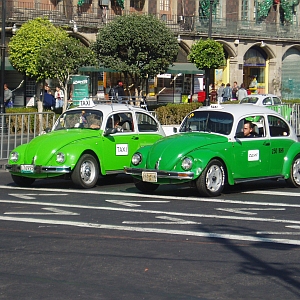
The picture reminds me of some good times had in Mexico City and a couple of key lessons regarding competition and simplicity. The famous old VW Beetle taxis are being phased out now but will remain in peoples thoughts forever. I will never forget the time I saw one carrying the fastest coffin in Mexico City.

Most were never in very good condition but somehow the drivers always seemed to be able to ply their trade. Many were modified by the removal of the front passenger seat. They were ideal vehicles for two people and a mountain of shopping.

The drivers were ingenious and found ways to keep the cars cool in hot weather and devised some very clever hacks to stop them being stolen. The cleverest (and most weird) thing I saw was during a ride around Mexico City late at night.

It was hot and we had the windows wound down whilst driving briskly (some might say VERY) across the city. We looked to our right and we were being overtaken by a green and white taxi with a huge coffin strapped to the top. This was not a small object but one of the enormous coffins favoured by the Roman Catholic church in Central and South America.

There was no roof rack or carrying device. The driver had wound down both side windows, laid a length of thick carpet over the roof, put the coffin on top (with some help I guess) and then used some stout rope to bind the coffin to the car by passing it through the car itself.

I assume that the driver then jumped in through the open window. I also made the assumption that the coffin was empty, but knowing Mexicans, it might not have been.

A nice story, I hear you ask, but what has this got to do with me? There are two real lessons to learn here.

The first is that ingenuity is not confined to the western or developed world. There are some very clever people everywhere and not just inventors. Not many years ago Aston Martin had some prototype cars made for the Geneva Motor Show – in India. The quality was superb and the cost was a fraction of what a UK or German company would have charged. Competition is everywhere.

The second lesson is that simplicity is key. How can you achieve the results you want in the most straightforward way? When we are out walking we try to find the shortest way home when we are tired, not try and be clever and find the most complicated.

Another example related to motor cars here! Cuba has for a long time been the subject of trade embargoes. Ingenious mechanics who desperately wanted brake fluid found that they did not need to try and work out the formula and then produce it in a manufacturing plant. They mixed a well known brand of shampoo with sugar – simple! This would not work for a car manufacturer of course but enabled some Cuban mechanics and car enthusiasts to remain on the road.

So remember, competition is everywhere and simplicity is key.

Image via Flickr “Taxis in Mexico City” by Steve Cadman, CC BY-SA 2.0

Can The Public Sector Leopard Change Its Spots?

can the public sector change

I went to an event very recently where a number of public sector and not for profit organisations were shouting very loudly about the joined up way in which they were working together and the great benefits that were being delivered to their customers.

On the face of it, this was exciting news but was everything as it seems? I can hear readers now thinking ‘he is going to have a go at the NHS’. Well in a way you would be right and in a way wrong. It is brilliant that service deliverers can improve and extend the range of services and observe genuine results.

So where is the problem? Well, the biggest one comes when someone reminds us that ultimately these organisations are spending our money. One of the people present who commissions services provided compelling evidence that these services were being effective. Commissioners have predictions for future service demand. This helps to ensure the amount and type of services required are actually there. The commissioner stated that demand was increasing much less than predicted which implies that prevention is working.

Well, that’s that then? Not quite. A gentleman asks politely but in a very ‘civil servant’ type of manner, what evidence he can put on the table at a meeting he is going to attend the next day. He wants facts (and lots of them) as do his colleagues (anyone with the word ‘Manager’ in their job title). We have a whole raft of people whose job it is to justify and account for spending.

The organisations are delivering new or altered services (great) but underneath they are fundamentally the same. This is a little like saying that a supermarket chain is changing and supporting the environment whilst all it is doing is stocking some local potatoes and getting rid of some plastic packaging.

We should remove whole swathes of middle management. We could then fund many more services if we could only change the way in which these organisations work. The public only turn their attention to accountability when the services they seek are not there. When GP visits are easy to make, when libraries are still there and functioning well, when refuse collections do not result in piles of waste on the street, we are all happy.

For a small example of how this can work see my article Ban The Boss – see the BBC’s Business Doctor at work. Its an hour long programme but well worth it.