How Will Coronavirus Change The World?

how will coronavirus change the world


The events which are unfolding across the world mean that post coronavirus, the world will never be the same again. Is this a good or a bad thing?

At a superficial level we have shown that if we stop driving, taking planes and in some cases manufacturing, we can actually reduce the number of toxic emissions in the air. It still leaves us with a whole load of problems to solve but it demonstrates that it CAN be done.

The coronavirus is affecting just about everyone on the planet, it is a major disruption. So will things return to normal after this?

The answer is most definitely not, but why? Well a number of things have been observed such as:

  • People being more caring towards those around them (mostly)
  • The mood of the people is playing a big part – do they want more restrictions or are they happy with what governments are doing
  • Some companies have shown that it is possible to be incredibly flexible
  • There are vast untapped resources of knowledge and expertise in our communities
  • Forced remote working can have huge benefits
  • The media can have a huge effect on the people

By and large, there have been plentiful supplies of food despite panic buying and some holdups in the supply chain. When it became obvious that there WAS enough to go round, we (in the UK at least) became British once more and queued peacefully.

Some questioned what the government and the police were doing but by and large, the people gave them a smack over the head!

So collectively we entered survival mode, realising that we had to get on in order to survive. Ignoring neighbours and panic buying food was not going to work long term.

So many of us would like to be able to work from home more (if not permanently). Just think if online shopping was cheaper and easier, we could create more leisure time for ourselves. What our UK government described as non-essential shopping would probably form the bulk of our shopping in the future.

Well, that is people taken care of but what about businesses? All businesses are in trouble right now but it should be survival of the fittest. Let us not subsidise poor businesses. For instance, airlines that treat customers badly and have poor service offerings might find themselves at the mercy of those who treat people better.

In the case of our own domestic supermarkets, those that took action early to adapt and look after vulnerable people will have a much-enhanced reputation when all this is over.

I have heard it said that the coronavirus spells the end of globalisation. I do not believe that this is so. The current globalisation is ‘globalisation of greed’, making profits anywhere and exploiting countries and their populations.

It is impossible for any country to be self-sufficient in everything so we will all have to ‘play nicely’ and there will be ‘globalisation of cooperation’ with know-how (rather than toilet rolls) being valued as a commodity.

Many businesses will be able to carry on, maybe with changes to their products and services. After all, we still require food and clothing. But the major shock to our world will also present opportunities for those that are ready and looking for them.

Nobody knows for sure where these sectors are but think of the following:

  • If people were happier to be at home, what sort of leisure activities would they favour?
  • Social distancing might mean that we don’t want to get too close but it might also force a drastic change in public transport systems
  • Companies would mainly be identified by groups of people and their values, not by buildings and equipment
  • There could be a huge demand upon the internet
  • If knowledge is a global currency will be tempted to travel more for work? If so, how can we reduce this?

Try asking yourself what has changed in your life and also look at the world from the point of view of a consumer. What would you like to see or not like to see?
Soft Infrastructure Post Coronavirus

soft infrastructure post coronavirus

What is soft infrastructure? We all understand the term ‘infrastructure’. It is a collective term for roads, railways, airports, ports, telecommunications networks, supply pipelines, etc. It is all to do with movement and these networks are all ‘hard’ i.e. they are made out of steel, concrete, and copper and they can all be touched.

Infrastructure is not quite the same as structure in an organisational context. Structure implies rigidity, a silo mentality and in many cases adherence to the past (especially in terms of behaviour). The new Organisational structures of the future will be more like infrastructures, offering support and guidance rather than controlling. Unlike the past, future (infra) structures will be wildly different, varying according to culture, market niche, company size, etc. They will, of course, all have one common theme – people.

Let us just take a break there. We could wander off into the future with some great ideas about what organisational structures could look like based on the opinions of experts and our own experiences.

There is just one tiny problem, something that is happening right now. We have a global pandemic and the measures that we are all taking are forcing us to work in very different ways compared to just a few weeks ago.

As a result, organisations might prefer to adopt some of these ways of working and as employees, we might prefer some of them too!

People need to be connected together in all sorts of ways. They are the valuable assets of the organisation and must be looked after by Human Resources, connected by IT and rewarded by the boss. But there is more, due to our dependence on intangible assets such as creativity, know-how, and culture as well as social interaction to create and exploit ideas.

For our businesses to function successfully, these things too must move around. Attempts have often been made in the past to codify these ideas, transmit them to another place and then try and extract both the message and the meaning of what has been received. Try having an email exchange with an angry colleague and you will understand the problems.

In order to have some sort of remote working, hierarchies will need to be flattened. Human nature means that those who imagine themselves with power like to be able to survey their empire and are not always comfortable viewing it remotely.

With many people away from work ill it will become apparent that a lack of employees at the coalface might reduce the capacity of an organisation to deliver a service of produce widgets. Capacity will not be reduced quite so much when those calling themselves ‘managers’ are taken out of the workforce or reallocated to other duties.

We need things to travel in ways that are not constrained by boundaries and which certainly do not travel in straight lines. Just like the ripples on a pond we might wish some things to be broadcast, such as company culture. And like a networked computer system we will need some sort of storage and perhaps some form of maintenance function to ensure that everything runs smoothly.

When thinking of communicating within a corporate environment we often think of sending things out (pushing) or receiving from others (pulling). What about when things just sort of slosh about, and proceed at their own pace or when disruptive events occur and we need a system that repairs or heals itself? We need a new type of infrastructure, one that is invisible and which connects everybody to everyone else. It must allow meaning, intuition, creativity and emotion to flow with no bottlenecks and no burst pipes. What we need therefore is the right sort of ‘network’ – a soft infrastructure rather than a hard structure .

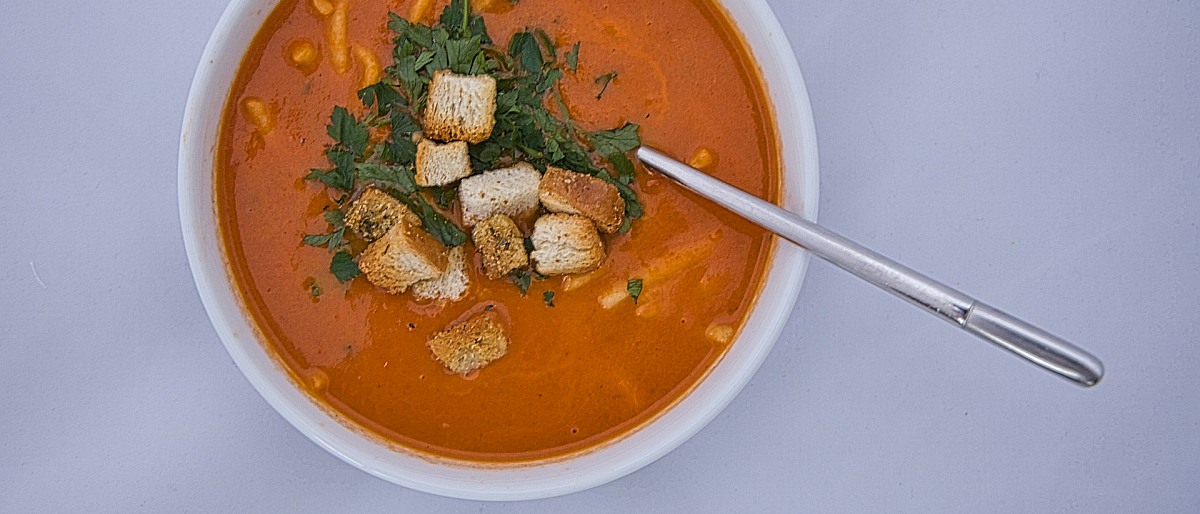
So what does this soft infrastructure actually look like? The best metaphor I have come up with is a bowl of soup with croutons!

The soup represents the entire organisation and its culture. It is organic and simply ‘exists’. The soup contains other ingredients and most importantly – croutons. The croutons are important but are not on a higher level, they are the leaders and managers of tomorrow.

Within this organisation, pay and rewards will depend more on what you know and who you connect with rather than your job title and position in the hierarchy.

So managers and leaders will be ‘expert’ i.e. good at their job, not just promoted for long service. Other employees will also be experts in manufacturing, finance and logistics. Yes employees can move around and change functional areas but only if they are good. No more ‘Peter Principle’.

If you are thinking about change right now you might like to read When The Threat Is Here, It Is Too Late To Change! For other recent articles visit Latest Blog Posts.

When The Threat Is Here, It Is Too Late To Change!

When is it too late to change

Here I shall use the spreading of deadly bacteria as a metaphor for change.

Consider a body of water that we all know well, the Mediterranean Sea. It has a volume (give or take a cupful) of 439 trillion litres.

Now imagine 1 litre of seawater with some of the deadliest bacteria known to man. This will contain around 1 trillion bacteria.

Imagine that these bacteria divide every minute so after 1 minute there are twice as many, after 2 minutes there are four times as many.

You like swimming in the ‘Med’ whilst on your summer holidays and have heard about these bacteria. How long do you think it will take before the whole body of water is filled with these deadly bacteria and we have another dead sea on our hands?

Is it weeks, months or perhaps years?

The alarming answer is a little over 68 minutes. I’m sure that we would have longer to get out and dry off before succumbing but this is alarming.

1 minute before ‘the end’ only 50% of the water is contaminated but this is still too late. 3 minutes before the end only 12.5% is contaminated but we have still left it too late. After a certain point, it is simply too late to change.

To save our beloved swimming destination we should really stop the deadly bacteria being put there in the first place or have developed some way of killing them.

My message here is all about taking action. When is it too late to change, when no amount of action will save our business? With rapid communications and lightning-fast technology, threats to our businesses are spreading ever more quickly. When we have spotted the threat and reacted it may actually be too late to change.

In the current climate, we need to be looking at what comes next. The old adage ‘if it ain’t broke don’t fix it’ does not apply, we need new products and services before our current ones become outdated.

Scientists amongst you will recognise this as a classic exponential curve. For some industries and countries, the steepness of the curve may vary but change in this day and age is much more rapid than in the industrial revolution.

Consider the current coronavirus as an interesting example. There are two aspects that we should be concerned with. The first is how contagious it is (change spreading at a local level) and how quickly it multiples and spreads on a global level. Let us apply this to the business world.

In business, changes made by our competitors will have varying effects on the marketplace and may be difficult (or easy to copy). Should we copy technology or develop our own to achieve the same ends (or perhaps add more value)?

How will change affect us and how quickly do we need to react?

Unlike my fictitious example of bacteria in the sea, we will have more than 68 minutes to react to serious business competition. But once a competitor produces something that threatens our products or services, how long have we got to live?

So what can we do? Well, the answer is to react like a chameleon does if that is the strategy that you wish to use. Change must be instant and you will need to be scanning your business environment to see as far ahead as possible.

You will not be able to use cumbersome decision-making processes and your sales, marketing, manufacturing, and distribution will need to change with very little input from senior management.

Another possible way of creating a strategy for the future is to look at the following:

  • Who are your customers?
  • What are you selling to them and why (what problem are you solving)?
  • What technology is coming over the horizon?
  • What skills do you possess as a company?
  • Who else is competing for your customers’ money?

Then consider the following just to start off with

  • How could you utilise new technology?
  • Can you make it lighter, heavier, smellier, greener …..?
  • Can you add value or combine products or services?
  • Can you use your skills to branch out into another sector?

Here are two examples.

I once met an author of children’s books who had just written a book about gardening. I introduced him to my list of things to think about and he immediately latched onto ‘add a smell’. The ‘scratch and sniff’ gardening book became a viable idea at that point.

Now consider a manufacturing company that makes a commodity such as mattresses. They have manufacturing expertise and knowledge of the human form but very little design skills. Find a designer and ‘hey presto’ you have the capability to design and manufacture higher value items such as furniture.

In the world of electronics, advances can be even more startling.

Remember, when change hits you it may already be too late to change.

Innovation + Reinvention = ReThinking

innovation, reinvention, rethinkingLet’s face it, the biggest problem that we have in the exciting world of creativeinnovationreinventiveness is the English language. Yes, I made that horrible big word up but I might as well use it because everyone else has their own definition of creativity, innovation, invention, etc.

You hire a consultant or adviser to give you some of the aforementioned and what do you get? I’m sure it is not what you thought you would get! So what is the point of this article?

Well, many think that you should be in one camp or another. Well, I believe there is a camp that we can all belong to. The idea that I believe that we can all buy into is what I call ReThinking.

The sceptical will be thinking that I am inventing another term to try and make money out of. Bear with me and I will explain.

Have you seen the innovation curve that for any technology gives the number of innovators (2.5%), early adopters (13.5%), early majority (34%), late majority (34%) and laggards (16%). It would seem that a very small percentage of us are actually innovators.

There is another term that has been used by others, reinvention. Here people take a look at what they are currently doing and rework or reinvent either their products or their company. Some might call this incremental innovation.

ReThinking incorporates both Innovation and Reinvention. This seems sensible to me as all of the skills and behaviours that need to be used are common. What is very different is the degree to which they are used and possibly the radical nature of the purpose to which they are put.

What is important here is the type of thinking that is used. If an external event occurs (say a stock market crash or a supplier shortage of bananas) how do we react appropriately? To fully understand, think of the Chameleon. It detects its surroundings and then blends in with the environment. It reacts appropriately.

What the Chameleon does not do is cycle through all of the psychedelic colour combinations it can until it settles upon the right one!

But your business is not a Chameleon, right? But it can be! First of all, you need to think of your business as being organic and not having a hard and fast structure. Whether you go to town on this is up to you, just don’t put up barriers where there do not need to be any.

Although employees might work in a particular department, such as production or finance they can all contribute to change processes that must exist.

A small but powerful example of this is the lorry drivers that transport goods around the country. They don’t just drive lorries though, do they? A driver often waits outside a factory or depot. They are sources of intelligence (or if you are mischievous, sources of misinformation!). How full are the lorries, where do they come from, and which haulage companies are being used?

Knowledge can be acquired from the environment by anyone and ideas can be generated by anyone. The next question is how do you gather them, how do you evaluate and then act on them? This is the essence of ReThinking, constantly thinking about what you do and whether you need to tweak things or react in a more drastic fashion.

As the recent outbreak of coronavirus has shown us, waiting until an infection is on our doorstep is far too late to take action in many cases. For businesses, it might just be a case of reacting to a future that is not here yet!

Be More Effective By Thinking Like A Film Director

be more effective, be like a film director Have you ever sat down at a computer screen or maybe a piece of A4 paper with a determination that you will ‘get that report written’ come what may. Days or perhaps weeks later you are still in exactly the same position. You need to be more effective, but how?

Why is that, especially when you know everything there is to know on the subject, you have your conclusions all ready and your boss has made their impatience obvious. You still can’t do it though, can you?

I have been the victim of this in the past and have observed this in those around me more recently. So what can be done about it?

Some readers will swear blind that a change of scenery will help and that the answer will come to them. At the risk of being controversial, I suggest that the change of scenery itself will not do the trick.

But in the process of changing the scene or moving around, something else is likely to change, your focus.

First of all, let us rewind a bit and take a look at the generic creative problem-solving process. In order for things to work efficiently, we need a series of divergent and convergent phases. First, work out what the problem might be (produce a range of causes) then work out what the cause actually is.

Similarly, we do the same with the solution to the problem.

So how do we relate this to our report writing scenario? Well, let’s go straight to the point where we are stuck. You have the facts, the conclusions, in fact, you have everything apart from a structure.

You also have a piece of paper or a laptop screen which is a bit like a small window. You are struggling to see something larger but through a small letterbox.

To help make things easier you can do any or all of the following:

  • Use a larger piece of paper (try flipchart)
  • Swap to your desktop PC with a 19inch monitor
  • Gather your thoughts in a non-linear fashion i.e. a mindmap

All of these will allow you to see the bigger picture. You are really just tricking your brain but widening the scope will make things easier. It will help you to be more effective.

When you have got your thoughts in order then you can bash out your document.

Those in Marketing might use storyboards (still linear but the steps can be modified or re-sequenced easily). Video and TV directors may very well do the same thing (ever wondered how a film director can shoot scenes out of sequence and still create a great film).

In a nutshell, widen your scope, get all the bits in focus then create your masterpiece.

Think like a film director!